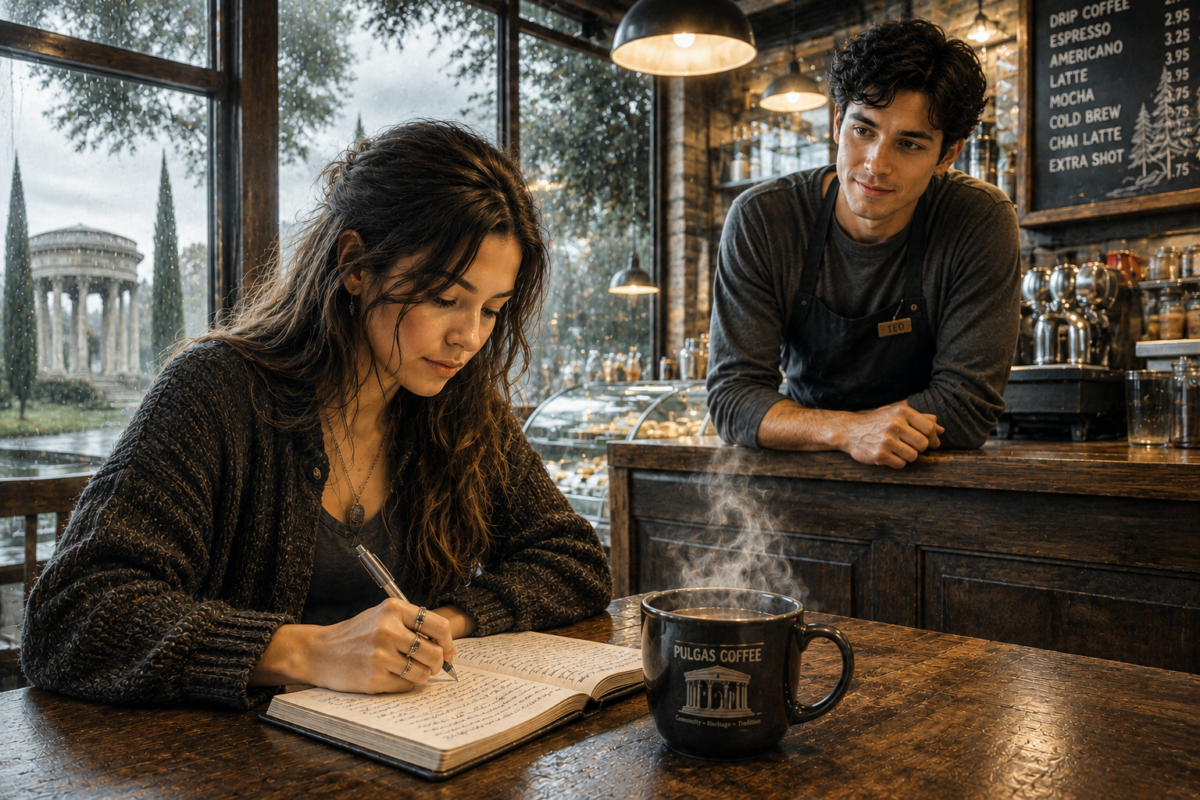
Before leaving California, a friendly barista started a conversation with me. He said my face was familiar. After a brief discussion, “Oh, yeah,” he said. “You’re that writer who writes creepy stuff. I follow your blog. And I’ve got one for you.”
He told me about a forgotten Greek temple. Where there are no crowds. No tour buses. Only silence. “But beneath the marble columns once flowed an entire mountain river,” he said.
I discovered a few facts after more research about why and for what purpose the temple builders constructed it. But nothing explained its silence.
A Few Facts
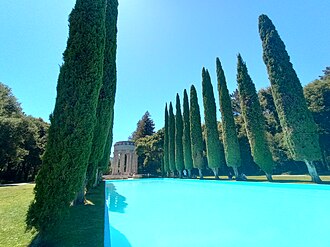
Hidden among cypress trees on the San Francisco Peninsula stands one of California’s most overlooked monuments. At first glance, the Pulgas Water Temple appears strangely out of place. A circle of elegant Corinthian columns rising from the rolling hills near Redwood City, more reminiscent of ancient Rome than modern California.
The temple’s purpose was not to inspire mystery, unlike abandoned churches or forgotten cemeteries. Engineers built it to celebrate one of the greatest achievements in California’s history.
Yet beneath its quiet beauty lies a story that raises an unsettling question: What happens when progress silences a landscape’s past?
History
Completed in 1938, the Pulgas Water Temple commemorates the arrival of water from the Hetch Hetchy Aqueduct. Stretching over 160 miles from the Sierra Nevada to the San Francisco Bay Area, the aqueduct transformed life for millions by providing a dependable supply of drinking water after the devastating 1906 San Francisco earthquake and fire exposed the city’s inadequate water system.
San Francisco architect William Merchant designed the monument in the Beaux arts style, drawing inspiration from the grand temples and aqueducts of ancient Greece and Rome. Originally, mountain water flowed beneath the temple before cascading into Crystal Springs Reservoir, allowing visitors to witness the very purpose of the monument. Today, modern treatment facilities divert the water elsewhere, leaving behind a tranquil reflecting pool and an uncanny silence.
But Before
The story begins long before marble columns and Roman architecture.
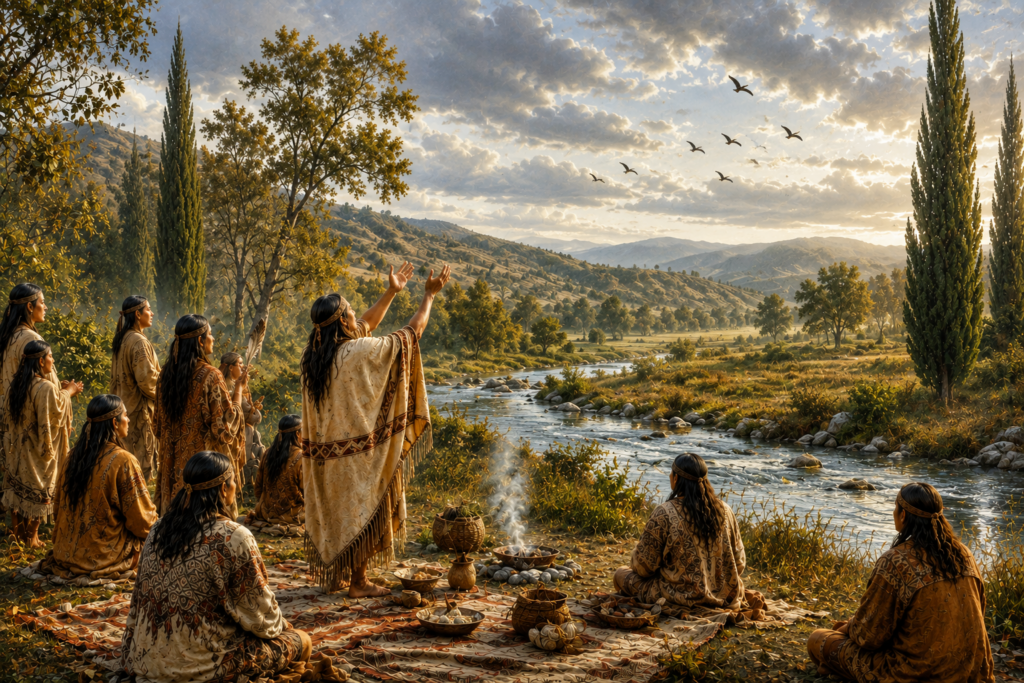
Centuries before Spanish explorers arrived, this land belonged to the Lamchin people, one of the many Ohlone communities who lived throughout the San Francisco Peninsula. Even the name “Pulgas” carries traces of that history. Historians believe Spanish missionaries translated part of the Lamchin village name into Las Pulgas, meaning “The Fleas,” a colonial interpretation that likely obscured the original Indigenous meaning.
Forgotten Temple
The water celebrated by the temple also carries another forgotten history.
Its journey begins in Hetch Hetchy Valley within Yosemite National Park, a place where Indigenous peoples lived, hunted, gathered plants, and conducted ceremonies for thousands of years. The early twentieth-century completion of the O’Shaughnessy Dam caused the valley to disappear beneath a reservoir. To many Californians, the project represented extraordinary progress.
To many Native communities, it marked the permanent loss of an ancestral homeland. That complicated history transforms the Pulgas Water Temple into something more than a monument to engineering. It stands as a reminder that every remarkable achievement often comes with a quieter story that risks being forgotten.
There are no famous ghost stories surrounding the temple. No phantom monks wander its columns. No spectral figures emerge from its reflecting pool.
Perhaps they are unnecessary.
Waiting
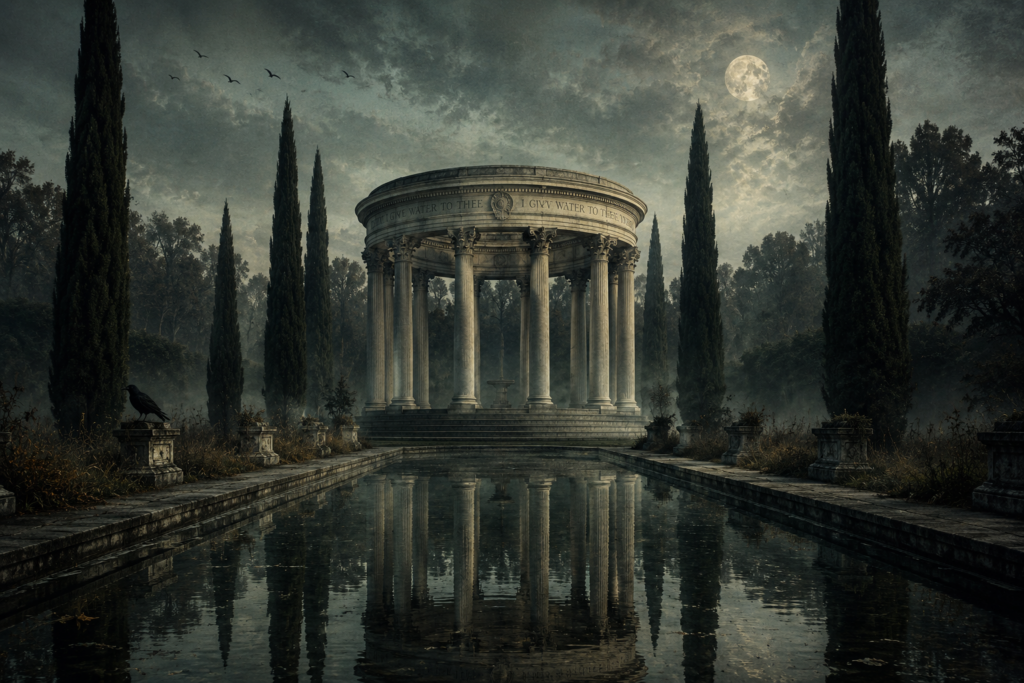
Some places possess an unease that defies explanation … even with its absence of ghosts. The Pulgas Water Temple invites visitors to admire human ingenuity while standing at the symbolic end of a river whose journey forever altered another landscape hundreds of miles away.
Maybe the silence surrounding the temple isn’t empty at all. Maybe it is the sound of history waiting to be remembered.
What do you think? Can places remember what people choose to forget?
FLASH FICTION
The Forgotten Temple
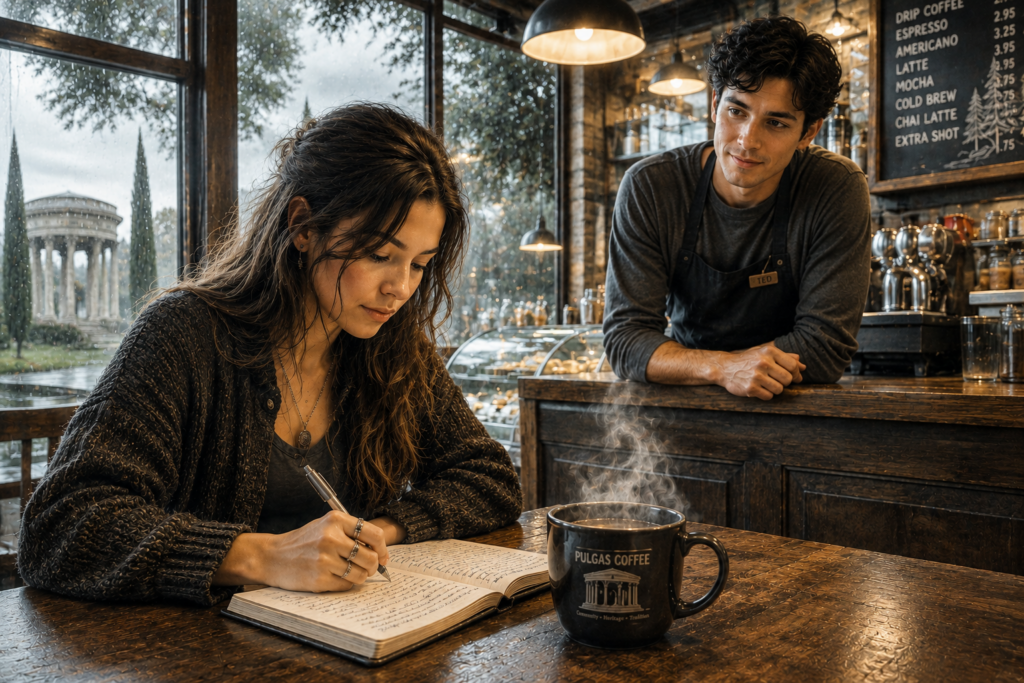
The café smelled of roasted coffee and rain-soaked cedar when Rio stepped inside.
She had spent the morning chasing forgotten histories around the Peninsula, filling another notebook with legends no one else seemed interested in. As a writer of creepy stories, she had learned that the best horrors rarely announced themselves. They waited patiently beneath ordinary places.
“Large dark roast?” a voice asked.
Rio looked up. The barista smiled as if he’d been expecting her.
He couldn’t have been much older than twenty-five, with dark hair that curled at the edges and eyes the peculiar color of storm clouds. His name tag simply read TED.
“You know my order?” she asked.
“I know your books.”
Rio laughed. “I don’t have books.”
“Not yet,” Ted replied. “But your stories have a way of finding people.”
A pleasant chill crept across her shoulders. “You’ve read my blog?”
“Every word.” He slid the steaming mug across the counter. “I especially liked the one about the ghost trees.”
Rio raised an eyebrow. “That article isn’t published until next week.”
Ted only smiled. By the time she looked down at her coffee and back again, he was already serving another customer.
Curiosity lingered far longer than the caffeine.
Remember
When the afternoon rush ended, Ted stepped outside and found her sitting beneath the awning, scribbling notes. “I know somewhere you’d like,” he said.
Rio smiled cautiously. “I’ve heard that line before.”
“I doubt you’ve heard this one.”
He nodded toward the hills. “There’s a forgotten temple.”
“Pulgas Water Temple?”
Ted shook his head. “No.”
His voice became almost reverent. “The one people stopped remembering.”
The Silence Begins
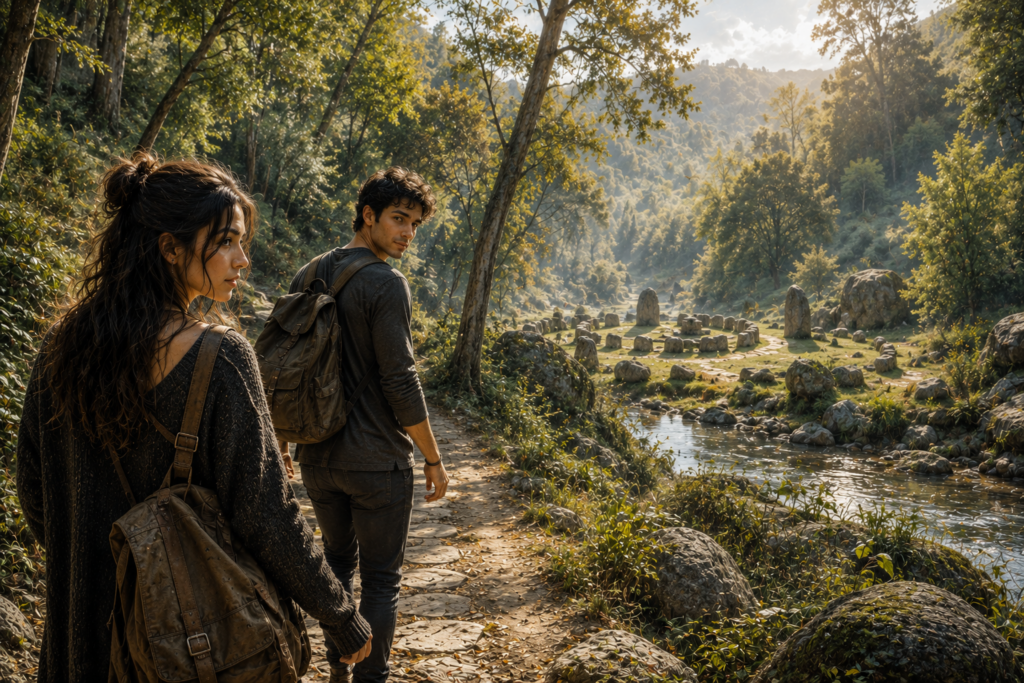
The trail began where the pavement ended. There were no signs. No maps. Only cypress trees swaying beneath an overcast sky.
Ted walked confidently, never hesitating, while Rio struggled to keep pace.
“I’ve never seen this trail.”
“You weren’t supposed to.”
The farther they walked, the quieter the world became. Birdsong disappeared. Wind faded.Even their footsteps seemed swallowed by the earth.
At last, they reached a clearing. There was no temple. Only weathered stones arranged in a perfect circle beside a slow-moving river.
“They’re gone,” Rio said. “The columns. The temple.”
Ted whispered. “They were never meant to be here.” Mist drifted across the water. The river reflected a sky that seemed older than the afternoon above them.
“What is this place?” Rio turned to him.
“A doorway.”
“What do you mean?”
Instead of answering, Ted stepped into the circle. The air rippled. Not dramatically. Softly. Like a memory disturbed beneath still water. The smell of cedar vanished. In its place came sage.
Wood smoke. Wildflowers. Voices. Hundreds of them.
Rio blinked. The hills had changed. The distant roads were gone. No telephone poles interrupted the horizon. The river ran wider now, clear enough to reveal polished stones beneath its surface.
People stood along its banks. Families. Children laughing. Women weaving baskets. Hunters returning from the hills.
Remembered
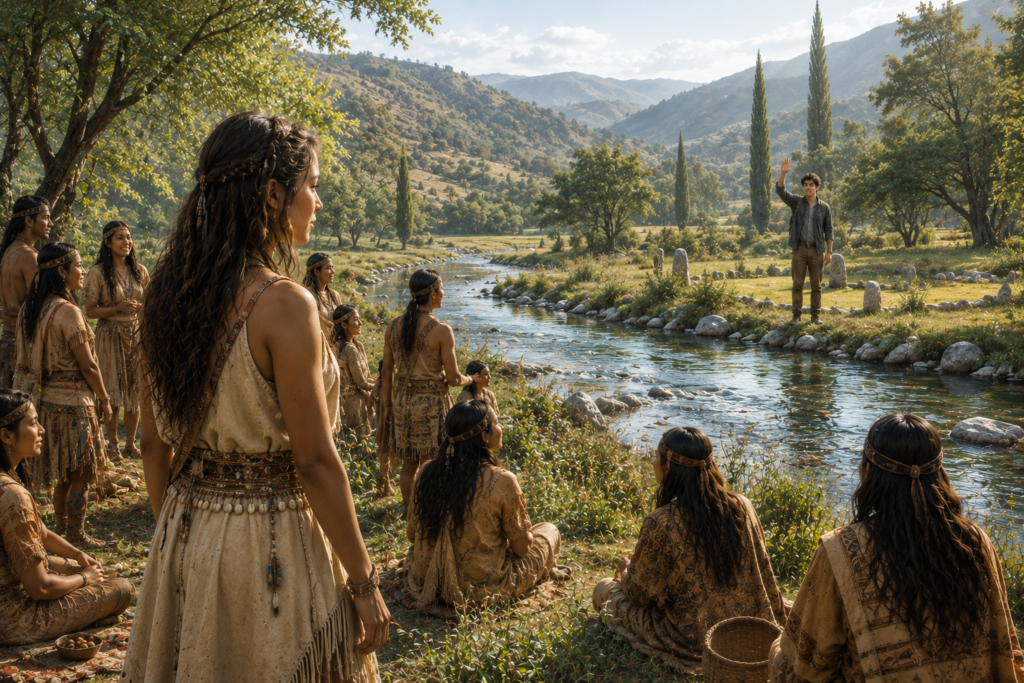
No one seemed surprised to see her. An elderly woman approached. She touched Rio’s cheek with weathered fingers. “You’ve come home.”
Rio opened her mouth to protest. Instead, unfamiliar words flowed effortlessly from her lips. Words she somehow understood. She looked down. The notebook had vanished. So had her jeans and hiking boots. She now wore a woven dress decorated with shells and feathers. Around her wrist rested a braided bracelet she did not remember making. Yet somehow had always owned.
“Ted,” she whispered.
He stood across the river. Smiling. The mist thickened between them.
“Wait!” She started forward. The river widened. Its current deepened.
Ted lifted one hand in farewell. “You wanted the real story.” The fog swallowed him.
By morning, no trace of the strange barista remained. The café employees insisted no one named Ted had ever worked there.
Security footage from that afternoon showed Rio speaking to an empty counter before walking alone toward the hills.
Search parties combed the trails for weeks. They found her backpack beside an old stone circle. Inside was a notebook. Every page was blank except the last one.
Written in careful, unfamiliar handwriting were three words. Don’t forget me. They never found Rio. Nor did anyone ever see Ted again.
But some evenings, when the fog settles over the Peninsula and the rivers grow strangely quiet, hikers claim they can hear laughter carried on the wind from a valley that disappeared beneath the waters long ago.
A valley where the Lamchin still walk beneath an untouched sky, and where every forgotten story waits patiently for its next storyteller.
Some stories don’t stay buried.
If you want more like this, you know where to find me.

- Creed, Colorado: The Bordello Ghosts - October 7, 2026
- Ghosts of Creede Hotel - October 6, 2026
- Bachelor Loop: Ghosts of Creede. - October 3, 2026